Saturday, March 7, 2015

who was bhimdatta panta

@ farwesternnepali.blogspot.com  
“Mother cries for her lost children, there’s nobody to understand here, murders and violence haven’t stopped yet, come on Buddha for Buddism is lost here, salute to those martyrs who made this country with their blood and sweat, down with those traitors that destroyed this country”
Bhimdatta has an enormous amount of love towards the country. He was driven by a great sense of justice to the people, whereas his approaches were revolutionary as well as activism for transformation. “Bhimdatta” was screened in center cinemas theater Sunnyside amidst prominent members of Nepalese community in the USA. A Nepali movie based on the life of the martyr Bhimdutta Pant was shot in far-western Nepal. The martyr Bhimdutta is known for his fight against the caste system and Rana autocracy. More than 60 percent of the movie was shot in the Western Nepal. In the history of Nepali movies, this is the first movie based on the life of a martyr. The movie titled ‘Bhimdutt’ was produced and directed by Himgyap Tasi Lama, who was trained in filming in Hollywood itself.
He was born in a village of Dadeldhura district seven decades ago and truly fought peacefully and with weapons against the existing exploitation, oppression and injustice. He put himself at the forefront of the struggle by sacrificing his own life for the cause of national sovereignty, national security and justice for the people. Although he comes from a Brahman family, he took a lead in eliminating caste based discrimination, including his own family. He grew up in a reasonably well off family. However, He could not tolerate the degree injustice, inequality, discrimination and exploitation in the society and thus dedicated himself ending such practices.
Peoples were suffering from feudal exploitation, corruption and caste based discrimination. In the mean time, there were growing, organized protests against the Rana regime in Nepal and British regime in India. There were string voices against the 1950 treaty between Nepal and India. In this context, Bhimdatta decided to fight the feudal authoritarian regime of Ranas. He opted on armed struggle as mean to this mission by forming his own group of fighters taking up arms. So, he took leadership of the people’s movement for eliminating feudal landlordism and its implication over innocent people. He gave a clear message to landlords, saying “you plough your land or you leave it, otherwise you may have to pay cost”.
He denied lucrative offers from the government and giving up his mission. He had firm determination for changing social and political system for the benefit of ordinary people. As a result, Bhimdatta did not receive the anticipated cooperation and support from the political parties and leaders. Nevertheless, he continued his mission with a strong sense of conviction and confident the help of local people and his force. His vision of society and need for change witnesses prosperous future of the ordinary people and thus he received mass support on the movement.
Nepalis and Indian government made several attempts to sabotage Bhimdatta’s struggle, but his agenda didn’t get defeated and his mission never stopped. Finally, they took the coward step of killing him through conspiracy. His own soul brother was used to kill him. He was killed on August 1953. This was the tragic and unfortunate moment where a freedom and Justice fighter had to end his life. Bhimdatta is an inspiration history of justice and change in the society. It was not easy to oppose justice socioeconomic and political practices and lead the movement in favor of voiceless and poor farmers during 1950s. He became ready to give up his position, status, facilities and also sacrifice his own life for the sake of people and the society.
This kind of determination, vision and awakening is still relevant and much anticipated in Nepali society even today. However, his contribution has not adequately been documented and recognized by the State. He has been living in the hearts and minds of many people as a symbol of justice and people’s true leader. The Bhimdutta whose controversial dialogues were made to be removed by Nepal Censor Board has been premiered in New York. Although censored in Nepal, New Yorkers had an opportunity to take a look at the original version of the movie. Censor board had allowed the movie to be released with the PG rating after removal of dialogues that denounced India.
A few days ago somebody called me to meet in Bhims café. When Journalist Prashan Alung Rai saw me, he said hello, he was sitting with film maker Him Gyap lama Tashi. He introduced me to his friends after that director lama invited me to a movie premiere. I was really excited to learn about martyrs Bhim Datta Pant. Finally, I did it. From a historical point of view, it was an awesome movie. I met many media personalities like Mr Bijaya Poudel, Kishor Panthi, Prashan Alung Rai, Pradeep Thapa, IT specialist of IMB company Mr. Shambhu Kadariya. Etc.
Several professionals, business people, social activists, artists and journalists gathered at a cinema center in Sunnyside, NY in order to watch the movie. After the crowd overflowed the hall, few audiences had to sit down on the floor to watch the movie. The movie also features songs based on the quotations of Bhimdutta and presents the attractions of Western Nepal. The movie made under Golden Films Pvt. Ltd. banner features Nawal Khadka, Shree ram Pudasaini, Nisha Adhikari, and Sumina Ghimire in lead roles. @ farwesternnepali.blogspot.com

Thursday, March 5, 2015

Ghodagodhi lake kailali


The Ghodaghodi Lake is as diverse and profound as the lake’s eco-diversity. In fact the name Ghodaghodi means male and female horse. One cosmic belief that has stood the test of time is that the lake is tied to a very popular event between two of Nepal’s most revered deities. Lord Shiva and Parvati were said to have visited the lake in different forms. A hermit came upon the deities and turned them into a horse. Once they were in horse form they then circled around the lake.


Other legends that surround the name of the lake revolve around the Chaudari people who took residence near it. They were always seen making various animal inspired artefacts yet, most are made of figures in the form of sacred horses. The Tharu people who are indigenous to this area also celebrate the Agan Panchami, every December they participate in a ritual where they take a holy bath in the lake. It has also become a place for traditional fishing and agricultural practices richly filled with their traditions.

The location of the lake itself is of ecological significance because it is a rich wetland area in the middle of the Far Western region near the Kailali district. Even though the lake is of similar importance to other wetland areas in Nepal, like the Koshi Tappu, it was not given as much significant. The lake is a Ramsar site and an international effort has been made for its protection and conservation. 3 VDC areas of Kailali area are covered by this lake.

The wetland area is surrounded by tree forests, shrub forests, village communities and their agricultural fields. Even though it is popularly known as the Ghodaghodi lake, another interesting thing about Ghodaghodi Lake is that it is actually made up of nine different lakes marked separately by marsh lands. The nine lakes present within the Ghodaghodi Tal are the Ghodaghodi, Chaitya, Sunpokhari, Nakhrodi, Budhi, Baishwa, Purbi Pjhuaw, Ojhuwa and the Ramphal.


The lake is composed of countless swaps, rivers, reservoirs, marshes, paddy fields and flood plains. All the bodies of water within the lake are filled entirely with fresh water. Of all the nine associated lakes, the Ghodaghodi is the biggest and is regulated by a cement dam because it is very close to a busy highway.

Due to the rising international concern to protect so many neglected wetlands all over the world, the Ghodaghodi has been pushed into the spotlight. It is the home of a large percentage of the world’s most diverse animal and plant species. Over 5.5% of Nepal is covered in these kinds of wetlands, all of them magnificently diverse yet dangerously shrinking.

The Ghodaghodi Tal is an important location for many resident and migratory birds. They not only call this place home but many of them mate and give birth to their offspring here. Upsetting this delicate balance could leave many of the animal residents at a loss. If it ever comes to pass that they will no longer have a place to mate and give birth then we would be witness to the extinction of many more important animal species.

In the year 2003 this was listed as a Ramsar site, the Lake area takes up an estimated 2,563 hectares of land. In addition to its sister lakes there are also a number of associated ponds. The forest surrounds the lake at the lower slopes of the Siwalik.

The most important part of Ghodaghodi Lake is that this lake is seen for more than its geographical aspects. The parts of its religious and ecological diversity must also be appreciated for their more important impact on our lives. 

Wednesday, March 4, 2015

होली के हो र कसरी ।

Holi is an important festival to Hindus. It is celebrated at the end of the winter season on the last full moon day of the lunar month Phalgun(February/March), (Phalgun Purnima


), which usually falls in March, sometimes in late February.
The festival has many purposes; most prominently, it celebrates the beginning of Spring. In 17th century literature, it was identified as a festival that celebrated agriculture, commemorated good spring harvests and the fertile land. Hindus believe it is a time of enjoying spring's abundant colours and saying farewell to winter. Holi festivities mark the beginning of new year to many Hindus, as well as a justification to reset and renew ruptured relationships, end conflicts and accumulated emotional impurities from past.
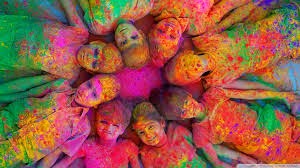
It also has a religious purpose, symbolically signified by the legend of Holika. The night before Holi, bonfires are lit, in a ceremony known as Holika Dahan (burning of Holika) or Little Holi. People gather near fires, sing and dance. The next day, Holi, also known as Dhuli in Sanskrit, or DhulhetiDhulandi or Dhulendi, is celebrated. Children and youth spray coloured powder solutions (Gulal) at each other, laugh and celebrate, while elders tend to smear dry coloured powder (Abir) on each other's face. Visitors to homes are first teased with colours, then served with Holi delicacies, desserts and drinks. After playing with colours, and cleaning up, people bathe, put on clean clothes, visit friends and family.
Like Holika Dahan, Kama Dahanam is celebrated in some parts of India. The festival of colours in these parts is called Rangapanchami, and occurs on fifth day after Poornima (full moon).

नेपालीहरु को रमाइलो को पर्ब फअल्गु पर्ब होली को हार्दिक मंगल्मय शुभकामना ।


picture of farwest nepal


this is my first blog to know about farwestern.......

The Far-Western Development Region ( Nepali: सुदुर पश्चिमाञ्चल विकास क्षेत्र, Sudur Pashchimanchal Bikas Kshetra) is one of Nepal's five development regions. It is located at the western end of the country with headquarters at Dipayal.
The Far Western Region covers 19,539 km. It has nine districts with the regional headquarters at Dipayal. Dothi district. The Far Western Region is remote and developmentally challenged. Some 44% of people in the Far West Hills and 49% in the Himalayan districts live beneath the poverty line. The region has limited access to basic services and increasing services is challenging due to the difficult topography. The region has complex social-economic structures and there is both widespread gender and caste based discrimination. Traditional systems associated with religion, culture and customs also have a great impact on overall development.